Self-Loading Concrete Mixer Rental in Odisha: AJAX Models, Price & When to Choose One Over a Transit Mixer
AJAX self-loading concrete mixers for rent in Odisha — ARGO 4000, ARGO 4500 & Udaan available now. Compare capacity and rental rates for Bhubaneswar, Cuttack, Rourkela & Berhampur.
If you’re pouring concrete on a rural road segment, a canal lining stretch, or a foundation in a colony a batching plant can’t reach, you already know the usual answer — a transit mixer, hauling concrete from a plant that might be an hour away, hoping it doesn’t start setting before it arrives. A self-loading concrete mixer skips that problem entirely: it’s a single machine that scoops its own aggregate, batches it to the mix design, mixes it, drives itself to the pour point, and discharges — no separate batching plant, no transit mixer, no water tanker.
Odisha’s construction pipeline right now is full of exactly the kind of work this machine is built for: PMGSY-IV has sanctioned 827 rural roads covering 1,701.84 km across the state, National Highway works worth ₹4,137 crore were inaugurated in April 2025 alone, and the Department of Water Resources completed 128.98 km of canal lining in FY2023-24 with more under active tender. Scattered, small-to-mid-volume, hard-to-reach pours — that’s the profile a self-loading mixer is designed around. We have three real AJAX self-loading mixers sitting idle in our fleet right now. Here’s what they are, how they work, and which one fits your site.
How a self-loading concrete mixer actually works
A self-loading concrete mixer (SLCM) does five things a conventional setup splits across three separate machines — loading, weigh-batching, mixing, transport, and discharge — all from one self-propelled unit.
- The loading bucket. A hydraulic front-mounted arm scoops aggregate directly from a stockpile, the same way a small front-end loader would, then lifts and tips the load into the drum’s inlet chute. This is the step that removes the need for a separate wheel loader or a manual shovel crew feeding a stationary mixer.
- On-board weighing. Load cells or pressure transducers, typically built into the loading bucket and drum support, weigh each material draft in real time as it’s loaded — sand, aggregate, cement, and water are metered to the mix design as they go in, rather than pre-batched at a plant and trusted to stay correctly proportioned through a long haul.
- The mixing drum. Internal spiral blades rotate the material for a full cycle — commonly around 12–15 minutes across the segment — producing a fresh, homogenous mix right at the pour point. Because water goes in on-site, there’s no risk of the load beginning to set, or being watered down mid-transit to stay workable.
- Discharge. The drum swivels through a wide arc — up to roughly 270° on many machines in this segment — so the operator can position the chute precisely over a footing trench, formwork, or canal lining form without needing a pump or chute extension for straightforward placements.
The practical upshot: fewer machines to mobilise, fewer drivers and operators to coordinate, and less that can go wrong between the plant and the pour.
Self-loading mixer vs. transit mixer: when each one actually makes sense
Neither is universally “better” — they solve different problems. A transit mixer paired with a fixed batching plant still wins for large, continuous, high-volume pours where a plant is already on or near site — think high-rise towers or a major dam. A self-loading mixer earns its place everywhere a fixed plant isn’t available, isn’t economical, or the work is too scattered to justify one:
- Remote or rural sites with no nearby batching plant. If the closest ready-mix plant is an hour or more away, transit-mixer concrete risks segregation, partial setting, or last-minute water correction before it’s even poured.
- Small-to-mid volume pours. Mobilising a batching plant is a fixed-cost decision that only pays off above a certain project size — a single house foundation, a boundary wall, or a short stretch of rural road rarely clears that bar.
- Multiple small pours spread across a large area. Canal lining and rural road segments are the textbook case — instead of running transit-mixer trips back and forth to one fixed plant, the SLCM drives between pour locations and batches a fresh load at each one.
- Tighter labour and lower waste. One operator runs the entire loading-batching-mixing-discharge sequence, and because concrete is mixed fresh on demand rather than trucked and potentially part-wasted, industry estimates put labour costs 15–25% lower and material waste meaningfully reduced versus a conventional multi-machine setup.
AJAX’s self-loading mixer heritage: the Ajax-Fiori story
The self-loading mixer itself isn’t a new idea — Fiori Group of Italy pioneered the swivel-drum design back in 1965, and the category has been globally proven for six decades. AJAX’s own roots trace directly back to that heritage: the company was incorporated in Bengaluru in 1992 as Ajax Fiori Engineering (India) Private Limited, a genuine joint venture with Fiori S.p.A. of Italy, built specifically to bring self-loading mixer technology to India.
In 2019, following a corporate restructuring, the company was renamed Ajax Engineering — today an independent, India-focused manufacturer (listed on the BSE/NSE since its February 2025 IPO) that has built on those three decades of SLCM-specific engineering to become India’s largest self-loading mixer maker, commonly cited at around 75% domestic market share. It’s worth being precise here: AJAX and Fiori are two separate, independently operating companies today, not current technology partners — but the self-loading mixer you’re renting from us carries three decades of purpose-built engineering behind it, rooted in the partnership that first brought the category to India.
Where Odisha’s construction pipeline needs these machines right now
This isn’t abstract — there’s real, active work across the state that fits the self-loading mixer’s exact use case:
- Rural roads (PMGSY-IV). 827 roads spanning 1,701.84 km have been sanctioned in Odisha at a cost of roughly ₹1,698 crore, connecting remote and underserved habitations — Odisha ranks 3rd nationally for PMGSY connectivity execution. Scattered, hard-to-reach pour locations are exactly what this machine was built for.
- National Highway works. ₹4,137 crore in road projects were inaugurated across Odisha in April 2025, with further bypass and expressway work moving through construction into 2026 — the connecting structures, culverts, and access roads within these programmes are realistic self-loading mixer territory, even where the main carriageway runs on a dedicated plant.
- Canal and irrigation lining. Odisha’s Department of Water Resources completed 128.98 km of canal lining in FY2023-24 alone, with more under active tender — long, linear, segmented pours across a wide geographic spread, precisely where mobilising a fixed plant per segment isn’t practical.
- Industrial estates. IDCO currently manages 116 industrial estates across roughly 10,900 acres statewide, with active MSME park development underway in Cuttack, Khurda, and Angul districts — the kind of distributed, mid-scale construction that suits a mobile, self-sufficient mixer.
Our self-loading mixer fleet
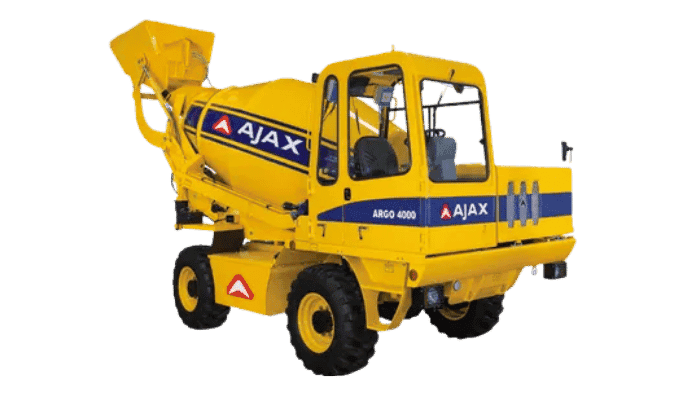
Three AJAX self-loading mixers, spanning compact to heavy-duty, sitting idle and ready to deploy across Odisha:
 Available
Ajax Udaan Self-Loading Concrete Mixer | Compact 0.8m³ Mobile Batching Plant
 Available
 Available
Which one should you rent?
| Machine | Drum capacity | Best for |
|---|---|---|
| AJAX Udaan | 0.8 m³ | Narrow colonies, rural lanes, small residential and boundary-wall work — anywhere a bigger machine can’t manoeuvre |
| AJAX Argo 4000 | 4.0 m³ | Foundations, canal lining, rural roads — large-volume work on rough or off-road terrain, with 4WD and 3-way steering for tight corners and steep gradients |
| AJAX Argo 4500 | 4.5 m³ class | The largest job on your site — high-volume, continuous pours where you want maximum output per trip from a single machine |
As a rule of thumb: match the machine to your tightest site access first, then your largest single pour. A compact machine that can actually get to every pour point beats a bigger one that has to stop short and hand off — but if your site is open and the pours are large, the bigger drum means fewer cycles to hit the same volume. Not sure which fits? Describe your job over a call and we’ll match you to the right one.
Self-loading mixer rental rates: what affects the price
Rental rates for self-loading mixers move with the same factors as any heavy equipment: drum capacity (bigger machines cost more per hour but move more concrete per cycle), rental duration (hourly rates drop meaningfully once you move to weekly or monthly block bookings), and site conditions (difficult access or long standby time between pours affects utilisation). Below are our current published rates for each machine — hourly, weekly, and monthly — so you can budget against your actual job size rather than guessing from a generic price list.
Frequently asked questions
What does SLCM stand for?
Self-Loading Concrete Mixer — a single machine that loads its own aggregate, batches, mixes, transports, and discharges concrete without a separate batching plant or transit mixer.
How is a self-loading mixer different from a transit mixer?
A transit mixer only transports and agitates concrete that’s already been batched at a fixed plant. A self-loading mixer does the batching and mixing itself, on-site, at the point of pour — so it doesn’t need a plant nearby at all.
Do you rent self-loading mixers outside Bhubaneswar?
Yes — our fleet moves across Odisha, including Cuttack, Rourkela, and Berhampur. Call or WhatsApp us with your site location and we’ll confirm mobilisation timing.
What’s the minimum rental period?
Our minimum is 8 hours (one shift), with weekly and monthly block rates available for longer jobs — block bookings work out cheaper per hour than repeated single-day hire.
Can I rent an AJAX self-loading concrete mixer in Odisha?
Yes. All three AJAX machines in our fleet — the compact Udaan, the mid-size Argo 4000, and the top-tier ARGO 4500 — are available for rent right now across Odisha, including Bhubaneswar, Cuttack, Rourkela, and Berhampur. Call or WhatsApp us with your site details for same-day availability.
Are these the same as the “Ajax Fiori” self-loading mixers listed elsewhere?
Yes — many rental listings still use the legacy “Ajax Fiori” name from AJAX’s original joint-venture era (1992–2019). The machines we rent are AJAX Engineering’s own Udaan, Argo 4000, and ARGO 4500 models, built on that same self-loading mixer engineering heritage, and available for rent now across Odisha.
Renting a self-loading concrete mixer in Odisha
All three machines are idle and ready to deploy now — no waiting on a manufacturing slot or a plant mobilisation schedule. Tell us your site location, pour volume, and access conditions, and we’ll match you to the right machine and confirm timing. Browse the full concrete mixer category for everything else in the fleet, or see how the rental process works end to end.
Call +91 90908 07015 or message us on WhatsApp to check availability and get a same-day quote.